 Reuben Shoub
Marketing Metrics That Matter Most This Year
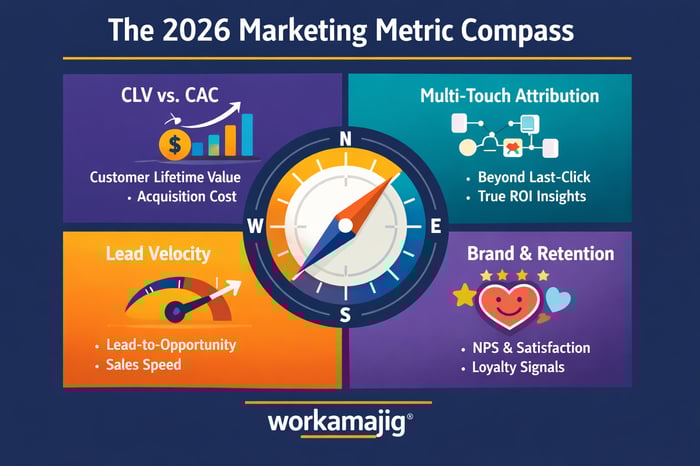
A strategic view of the core marketing KPIs agencies must align around in 2026
Marketing hasn't just changed—it's been fundamentally rewritten. The strategies that felt bulletproof last year now gather dust in outdated playbooks. Here's what I've learned after spending years in the trenches at Workamajig: tracking marketing KPIs isn't about drowning in spreadsheets. It's about identifying which metrics actually illuminate your path forward, helping marketing agencies and brands optimize their marketing efforts for genuine revenue growth.
We're past the era of vanity metrics and surface-level reporting. The marketing agencies and brands that thrive in 2026 will be those that understand not just what their numbers say, but why those numbers matter and how to act on them. This demands more than static dashboards—it requires a fundamental shift in how we approach marketing measurement. It’s about creating a holistic marketing measurement plan that provides real-time insights and allows for strategic adjustments.
Customer Lifetime Value: Your True North
I'll be direct: we've been doing this wrong. Marketing teams have obsessed over customer acquisition costs and conversion rates while missing the forest for the trees. Customer Lifetime Value (CLV) deserves center stage in your marketing strategy, and here's why—keeping new clients and existing ones costs dramatically less than hunting for new ones. CLV tells you whether your business model actually works to attract new customers, foster strong customer retention, and is built to maintain a low churn rate.
But calculating CLV in 2026 isn't yesteryear’s spreadsheet formula. We're now layering in predictive analytics, behavioral modeling, and cross-channel engagement patterns. At Workamajig, I've watched our data-driven unified approach transform how agencies calculate and forecast customer value. This isn't just another financial metric to report—it's a litmus test for whether you're actually delivering value or just making noise. Many marketing departments use CRM systems to track and enhance this vital metric.
The marketing agencies nailing this? They're using CLV to drive every decision: budget allocation, resource planning, and even which clients to pursue. They understand that maximizing customer lifetime value means building relationships that compound over time. Focusing on CLV helps streamline resource management and ensures optimal marketing spend.
Integrated ROI and Multi-Touch Attribution: Death of the Last-Click Myth
Let's bury a dangerous fiction: the last-click attribution model. It's 2026, and crediting the final touchpoint before conversion is like giving the Closer credit for the entire baseball game. Return on Investment (ROI) matters more than ever, but only when you measure it properly.
The digital marketing ecosystem has become impossibly complex. Your customer's journey weaves through brand awareness campaigns, blog content, social media interactions, and paid search—often across weeks or months. Multi-touch attribution models reveal which marketing channels actually drive value versus which ones just happen to be there at the end. For digital marketing agencies, understanding SEO impact alongside paid search is paramount. It’s also crucial to benchmark performance against industry standards.
I've seen marketing agencies waste enormous marketing budgets because they couldn't see the full picture. That initial brand awareness campaign? It planted the seed. The nurturing blog content? It built trust. Your attribution model needs to account for all of it. Marketing performance analytics tools that offer comprehensive tracking aren't luxuries anymore—they're requirements for survival. These tools often leverage templates for clear reporting.
This holistic view doesn't just optimize marketing spend. It proves value to stakeholders who want to see concrete ROI from every dollar invested in digital marketing.
Lead-to-Opportunity Ratio and Sales Velocity: Where Marketing Meets Revenue
Here's an uncomfortable truth: generating qualified leads is easy. Generating qualified leads that actually convert and deliver a projected number of new customers? That's where most marketing teams stumble.
The lead-to-opportunity ratio cuts through the noise. It tells you whether your marketing efforts are attracting window shoppers or serious buyers. But there's another piece to this puzzle that separates good marketing agencies from great ones: sales velocity.
Sales velocity measures how quickly qualified leads move through your marketing funnel and become paying customers. I've watched marketing teams generate impressive lead numbers while their sales velocity crawled. That's not a marketing win—it's a symptom of deeper problems in your marketing strategy or sales closing ratio. The overall conversion rate is a key indicator here.
The solution? Marketing and sales teams need to operate as one unit, sharing data and insights in real-time. When your martech platform (perhaps a SaaS solution like Workamajig) connects these dots, you can spot bottlenecks immediately and adjust your marketing campaign strategies on the fly. This alignment ensures your marketing KPIs directly correlate to revenue growth instead of existing in a vacuum. It also helps with more effective project management within the agency.
Brand Health and Employee Satisfaction: The Invisible Engines
This might sound soft to executives obsessed with hard numbers, but hear me out: brand health and employee satisfaction are leading key performance indicators of everything else on this list. They drive overall agency performance.
Brand awareness KPIs have evolved beyond simple reach metrics. We're now tracking sentiment, engagement quality, and genuine brand advocacy. How do people actually talk about your brand online? What's the real conversation happening around your company? These signals predict customer acquisition costs (CAC), retention rates, and market positioning months before they show up in your revenue numbers.
Employee satisfaction carries equal weight. Burned-out marketing teams don't build innovative marketing campaigns. Disengaged employees can't deliver exceptional client service and have high client retention rates. I've seen the direct correlation: agencies with high employee satisfaction consistently outperform on every other marketing KPI that matters. Happy teams create happy customers, who generate better marketing results, which feed back into team morale and ensure client retainer renewals. A smooth onboarding process also contributes significantly to client satisfaction.
These aren't fluffy "nice-to-haves." They're foundational elements that support every other key performance indicator in your marketing stack.
Monthly Recurring Revenue and Profit: The Heartbeat of Your Agency
If you run a marketing agency and you're not obsessing over Monthly Recurring Revenue, what I am going to share can make a big difference for your business. MRR represents your baseline—the revenue you can count on month after month. It's the difference between constantly scrambling for new business and building sustainable growth.
But here's where most agencies make a critical mistake: they track MRR without looking at Monthly Recurring Profit. Total revenue means nothing if your costs exceed your income and your profit margins have evaporated. Tracking both metrics together shows you the real health of your business and helps you make smarter decisions about pricing, investment, and growth, ensuring healthy cash flow and agency profitability.
Net profit margin is equally non-negotiable. You can have impressive client lists and beautiful case studies, but if you're not profitable, you're just running an expensive hobby. The most successful marketing agencies I know manage profitability first, knowing that sustainable growth depends on healthy margins.
Retention Rate and Net Promoter Score: Keep What You Kill
Acquiring new clients costs five times more than keeping existing ones. That's not theory—it's documented reality. Yet I constantly see marketing agencies pour marketing spend into new business development while their retention rate slowly crumbles.
Your retention rate reveals whether you're actually delivering value or just delivering promises. Low retention means clients aren't seeing ROI from your services. High retention—especially when paired with account growth—proves you're solving real problems.
Net Promoter Score (NPS) complements this by measuring client satisfaction and loyalty. Are your clients willing to recommend you? NPS cuts through polite feedback and reveals genuine sentiment. The agencies tracking NPS regularly and actually acting on the feedback create self-sustaining referral engines. They're not just keeping clients happy; they're turning them into advocates. Referrals are a critical lead source.
Primary Lead Source and MQL/SQL Tracking: Know Your Pipeline
Every marketing agency preaches to clients about tracking lead sources, then somehow forgets to do it themselves. Don't be that agency. Understanding whether your best clients come from referrals, paid ads, content marketing, or organic search fundamentally shapes your marketing strategy and budget allocation. You might even want to consider building a dedicated landing page for different campaigns to better segment leads.
But lead source is just the beginning. Marketing Qualified Leads (MQLs) and Sales Qualified Leads (SQLs) tell you how efficiently your marketing funnel converts interest into opportunity. A healthy MQL-to-SQL conversion rate means your marketing team is targeting the right audience and setting proper expectations. Poor conversion? You're either attracting the wrong people or overpromising in your marketing materials.
Track these metrics religiously. They'll tell you where to double down and where to cut losses long before revenue numbers confirm it.
The Strategic Measurement Imperative
Looking ahead, one thing is certain: the marketing agencies and brands that succeed in 2026 won't be those with the most data. They'll be the ones who know which data matters and how to act on it.
This requires moving past rudimentary dashboards and embracing platforms that provide genuine marketing performance analytics. It means integrating your data sources so you can see the complete picture instead of disconnected fragments. It means measuring what drives sustainable growth rather than what makes pretty charts.
The future of marketing measurement is holistic, strategic, and action-oriented. It's about using marketing KPIs to guide every decision, from budget allocation to marketing campaign strategy to team structure. It's about understanding that every metric tells a story, and your job is to connect those stories into a coherent narrative that drives results.
So here's my challenge to you: audit your current marketing measurement plan. Are you tracking vanity metrics or actual value drivers? Are your marketing teams aligned around common key performance indicators? Can you clearly articulate how your marketing efforts contribute to bottom-line growth?
If you hesitated on any of those questions, it's time to evolve your approach. The tools exist. The frameworks work. The only question is whether you're ready to do the work of strategic measurement that separates thriving marketing organizations from those just going through the motions.
Are your marketing KPIs ready for 2026? The answer will determine whether you're leading the pack or struggling to keep up.